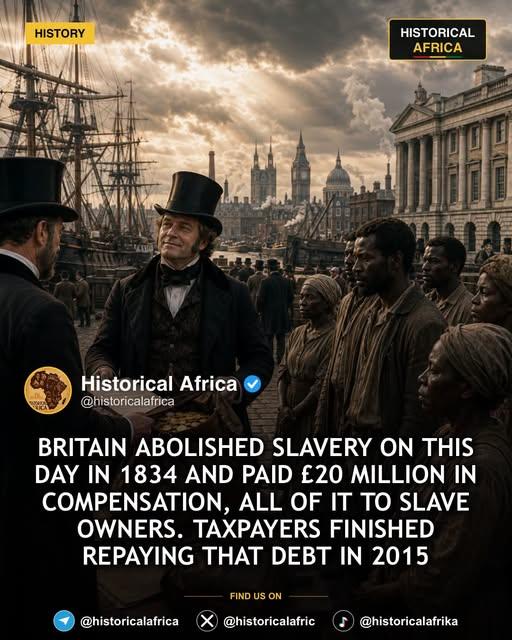
• On this day in 1834 slavery ended in the British Empire, and the compensation went to the slaveholders
    On 1 August 1834, the Slavery Abolition Act came into force across most of the British Empire. On paper, hundreds of thousands of enslaved Africans and their descendants were declared free. It is remembered as one of the great moral corrections in history, and today it is marked as Emancipation Day across Jamaica, Trinidad and Tobago, Barbados, Guyana, Grenada and beyond.
    But read the full title of the law Britain actually passed. An Act for the Abolition of Slavery throughout the British Colonies, for promoting the Industry of the manumitted Slaves, and for compensating the Persons hitherto entitled to the Services of such Slaves. Compensation. Not for the people who had been owned, worked, whipped and sold. For the people who had owned them.
    Britain paid out around £20 million to more than 40,000 slave owners for the loss of what the law called their property. That sum was roughly 40 percent of the entire national budget at the time, one of the largest payouts in British history. The formerly enslaved received nothing at all. Not land, not wages for generations of stolen labour, not a shilling. As one account of the period put it, the prevailing feeling was that their freedom was compensation enough.
    And freedom itself was delayed. Everyone over the age of six was reclassified as an apprentice, forced to keep working unpaid for their former owners, up to 45 hours a week. Household workers were bound for four years, field workers for six. Slavery had simply changed its name.
    The people it was done to saw through it instantly. On that very first day, 1 August 1834, in Port of Spain, Trinidad, a crowd of mostly elderly formerly enslaved people stood before the Governor as he explained the new arrangement, and drowned him out with a chant. Pas de six ans. Point de six ans. Not six years. No six years. They kept protesting until the system broke. Apprenticeship was abolished early, and full freedom came on 1 August 1838. The enslaved freed themselves from the second trap too.
    Now here is the fact that should be taught in every school on this continent and in the diaspora. Because that £20 million was borrowed and partly converted into government annuities, British taxpayers were still repaying the loan used to compensate slave owners until **2015**. Britain spent 180 years paying the families of slaveholders. It has never paid one penny to the descendants of the enslaved.
    So when Britain says today that reparations are too complicated, too historical, too expensive to calculate, remember that it already calculated the value of every enslaved African with total precision. It just paid the money to the wrong people, and kept paying for nearly two centuries.
    #HistoricalAfrica #EmancipationDay #Reparations #BlackHistory #Slavery

    On this day in 1834 slavery ended in the British Empire, and the compensation went to the slaveholders On 1 August 1834, the Slavery Abolition Act came into force across most of the British Empire. On paper, hundreds of thousands of enslaved Africans and their descendants were declared free. It is remembered as one of the great moral corrections in history, and today it is marked as Emancipation Day across Jamaica, Trinidad and Tobago, Barbados, Guyana, Grenada and beyond. But read the full title of the law Britain actually passed. An Act for the Abolition of Slavery throughout the British Colonies, for promoting the Industry of the manumitted Slaves, and for compensating the Persons hitherto entitled to the Services of such Slaves. Compensation. Not for the people who had been owned, worked, whipped and sold. For the people who had owned them. Britain paid out around £20 million to more than 40,000 slave owners for the loss of what the law called their property. That sum was roughly 40 percent of the entire national budget at the time, one of the largest payouts in British history. The formerly enslaved received nothing at all. Not land, not wages for generations of stolen labour, not a shilling. As one account of the period put it, the prevailing feeling was that their freedom was compensation enough. And freedom itself was delayed. Everyone over the age of six was reclassified as an apprentice, forced to keep working unpaid for their former owners, up to 45 hours a week. Household workers were bound for four years, field workers for six. Slavery had simply changed its name. The people it was done to saw through it instantly. On that very first day, 1 August 1834, in Port of Spain, Trinidad, a crowd of mostly elderly formerly enslaved people stood before the Governor as he explained the new arrangement, and drowned him out with a chant. Pas de six ans. Point de six ans. Not six years. No six years. They kept protesting until the system broke. Apprenticeship was abolished early, and full freedom came on 1 August 1838. The enslaved freed themselves from the second trap too. Now here is the fact that should be taught in every school on this continent and in the diaspora. Because that £20 million was borrowed and partly converted into government annuities, British taxpayers were still repaying the loan used to compensate slave owners until **2015**. Britain spent 180 years paying the families of slaveholders. It has never paid one penny to the descendants of the enslaved. So when Britain says today that reparations are too complicated, too historical, too expensive to calculate, remember that it already calculated the value of every enslaved African with total precision. It just paid the money to the wrong people, and kept paying for nearly two centuries. #HistoricalAfrica #EmancipationDay #Reparations #BlackHistory #Slavery

    0 Comments ·0 Shares ·654 Views ·0 Reviews
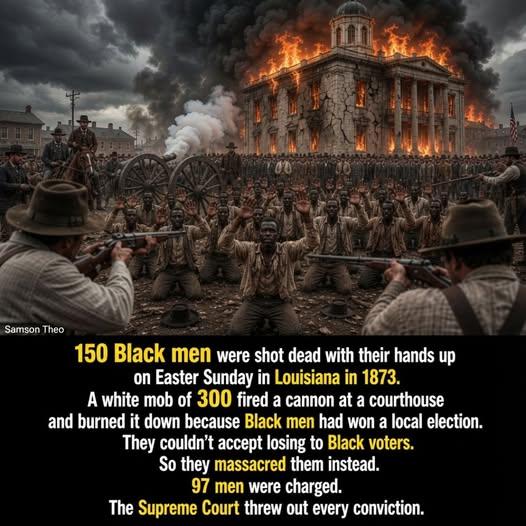
  • One of the deadliest acts of political violence in American history happened on Easter Sunday and most people have never heard of it.
    On April 13, 1873, in Colfax, Louisiana, hundreds of armed white supremacists attacked the Grant Parish courthouse, where Black citizens and members of the state militia had gathered to defend the results of a disputed local election during Reconstruction.
    Just five years after the Civil War ended, Black men had gained the right to vote and hold public office. In Grant Parish, they helped elect Republican officials. Many white Democrats refused to accept the outcome.
    Determined to seize power by force, an estimated 300 armed men surrounded the courthouse. They fired a cannon into the building and set it ablaze. As the defenders tried to surrender or escape, many were shot where they stood. Others were hunted down and executed after being captured.
    Historians estimate that at least 150 Black men were killed in what became known as the Colfax Massacre, making it one of the bloodiest racial massacres of the Reconstruction era.
    Federal authorities charged 97 men under the Enforcement Acts, laws designed to protect the civil rights of newly freed African Americans.
    But in 1876, the U.S. Supreme Court overturned the convictions in United States v. Cruikshank, ruling that the federal government had only limited power to prosecute individuals for violating the civil rights of others. The decision severely weakened federal enforcement against racial terrorism and emboldened white supremacist groups across the South for decades.
    No one was ultimately held accountable for the massacre.
    The Colfax Massacre remains a powerful reminder of the violent resistance that followed emancipation and of the long struggle to protect the right to vote in the United States.
    History should be remembered not forgotten.
    One of the deadliest acts of political violence in American history happened on Easter Sunday and most people have never heard of it. On April 13, 1873, in Colfax, Louisiana, hundreds of armed white supremacists attacked the Grant Parish courthouse, where Black citizens and members of the state militia had gathered to defend the results of a disputed local election during Reconstruction. Just five years after the Civil War ended, Black men had gained the right to vote and hold public office. In Grant Parish, they helped elect Republican officials. Many white Democrats refused to accept the outcome. Determined to seize power by force, an estimated 300 armed men surrounded the courthouse. They fired a cannon into the building and set it ablaze. As the defenders tried to surrender or escape, many were shot where they stood. Others were hunted down and executed after being captured. Historians estimate that at least 150 Black men were killed in what became known as the Colfax Massacre, making it one of the bloodiest racial massacres of the Reconstruction era. Federal authorities charged 97 men under the Enforcement Acts, laws designed to protect the civil rights of newly freed African Americans. But in 1876, the U.S. Supreme Court overturned the convictions in United States v. Cruikshank, ruling that the federal government had only limited power to prosecute individuals for violating the civil rights of others. The decision severely weakened federal enforcement against racial terrorism and emboldened white supremacist groups across the South for decades. No one was ultimately held accountable for the massacre. The Colfax Massacre remains a powerful reminder of the violent resistance that followed emancipation and of the long struggle to protect the right to vote in the United States. History should be remembered not forgotten.
    0 Comments ·0 Shares ·526 Views ·0 Reviews
  • Europe forced 12.5 million Africans onto slave ships 1500 - 1866 💔Approximately 2 million died during the Middle Passage. Their bodies rest in the Atlantic. The routes are documented. The ships are named. The captains are recorded. This happened."
    Trade Database documents 36,000 slave voyages. Names of 91,491 enslaved Africans have been recovered. 12 million more remain unnamed." #facts
    Europe forced 12.5 million Africans onto slave ships 1500 - 1866 💔Approximately 2 million died during the Middle Passage. Their bodies rest in the Atlantic. The routes are documented. The ships are named. The captains are recorded. This happened." Trade Database documents 36,000 slave voyages. Names of 91,491 enslaved Africans have been recovered. 12 million more remain unnamed." #facts
    Like
    Angry
    Sad
    7
    ·
    0 Comments ·0 Shares ·5K Views ·0 Reviews
  • A dramatic video capturing a self-proclaimed prophet attempting to replicate the biblical parting of the Red Sea has ended up drawing widespread mockery and renewed debate over extreme religious stunts. The footage depicts an unidentified man marching boldly into crashing ocean waves in front of his gathered congregation. As he enters the water making dramatic hand gestures to divide the sea, an assistant stands nearby on the shoreline, aggressively shouting and reciting holy scriptures. The demonstration quickly took a perilous turn when a series of powerful swells completely engulfed the man. Nearly drowning on camera, the preacher abandoned his supernatural claims, fleeing back to dry land in a state of visible panic as the ocean refused to yield. While widely circulated within West African media as a "Nigerian Pastor" incident, local digital outlets note the video mirrors identical, historical miracle failures reported across Central and East Africa. The preacher was explicitly attempting to recreate the Parting of the Red Sea, one of the most famous supernatural events recorded in Abrahamic theology. According to religious texts in the Book of Exodus, the Prophet Moses used a divinely powered staff to split the ocean waters into two towering walls. This created a path of dry ground that allowed the Israelites to escape slavery from the pursuing Egyptian army. #africa #news #religion
    A dramatic video capturing a self-proclaimed prophet attempting to replicate the biblical parting of the Red Sea has ended up drawing widespread mockery and renewed debate over extreme religious stunts. The footage depicts an unidentified man marching boldly into crashing ocean waves in front of his gathered congregation. As he enters the water making dramatic hand gestures to divide the sea, an assistant stands nearby on the shoreline, aggressively shouting and reciting holy scriptures. The demonstration quickly took a perilous turn when a series of powerful swells completely engulfed the man. Nearly drowning on camera, the preacher abandoned his supernatural claims, fleeing back to dry land in a state of visible panic as the ocean refused to yield. While widely circulated within West African media as a "Nigerian Pastor" incident, local digital outlets note the video mirrors identical, historical miracle failures reported across Central and East Africa. The preacher was explicitly attempting to recreate the Parting of the Red Sea, one of the most famous supernatural events recorded in Abrahamic theology. According to religious texts in the Book of Exodus, the Prophet Moses used a divinely powered staff to split the ocean waters into two towering walls. This created a path of dry ground that allowed the Israelites to escape slavery from the pursuing Egyptian army. #africa #news #religion
    Haha
    2
    ·
    2 Comments ·0 Shares ·4K Views ·0 Reviews
  • Amin ruled Uganda from 1971 to 1979, a period marked by political repression, widespread human rights abuses, and the deaths of hundreds of thousands of people. His government became notorious for silencing critics and ruling through fear. Whether viewed as a warning, a threat, or a reflection of the era, the quote remains one of the most chilling statements associated with a modern African leader. Today, it continues to be cited as a reminder that freedom of speech means little if people fear the consequences of speaking openly. #africa
    Amin ruled Uganda from 1971 to 1979, a period marked by political repression, widespread human rights abuses, and the deaths of hundreds of thousands of people. His government became notorious for silencing critics and ruling through fear. Whether viewed as a warning, a threat, or a reflection of the era, the quote remains one of the most chilling statements associated with a modern African leader. Today, it continues to be cited as a reminder that freedom of speech means little if people fear the consequences of speaking openly. #africa
    Like
    5
    ·
    1 Comments ·0 Shares ·2K Views ·0 Reviews
  • Bana Tribe Ethiopia
    #Ethiopia #africa
    Bana Tribe Ethiopia #Ethiopia #africa
    Like
    Love
    4
    ·
    0 Comments ·0 Shares ·1K Views ·0 Reviews