

• A 17-year-old boy was killed because he drifted a few feet too far while swimming.
    His death became the spark that ignited one of the deadliest racial conflicts in Chicago’s history — the 1919 Chicago Race Riot.
    What happened next exposed a painful reality: a simple act of being in the wrong place could cost a Black person their life.
    History remembers Eugene Williams — not just as a victim, but as a reminder of the struggles that shaped America.
    Follow for more untold stories from history.
    #nowaythisisreal #truestory #blackhistory #injustice #history
    A 17-year-old boy was killed because he drifted a few feet too far while swimming. His death became the spark that ignited one of the deadliest racial conflicts in Chicago’s history — the 1919 Chicago Race Riot. What happened next exposed a painful reality: a simple act of being in the wrong place could cost a Black person their life. History remembers Eugene Williams — not just as a victim, but as a reminder of the struggles that shaped America. Follow for more untold stories from history. #nowaythisisreal #truestory #blackhistory #injustice #history
    Like
    Love
    3
    ·
    0 Комментарии ·0 Поделились ·19Кб Просмотры ·0 предпросмотр
  • He Was Enslaved There — Then He Bought It!
    They couldn't stop him. 🤯 #BlackHistory
    He Was Enslaved There — Then He Bought It! They couldn't stop him. 🤯 #BlackHistory
    Like
    1
    ·
    0 Комментарии ·0 Поделились ·6Кб Просмотры ·0 предпросмотр
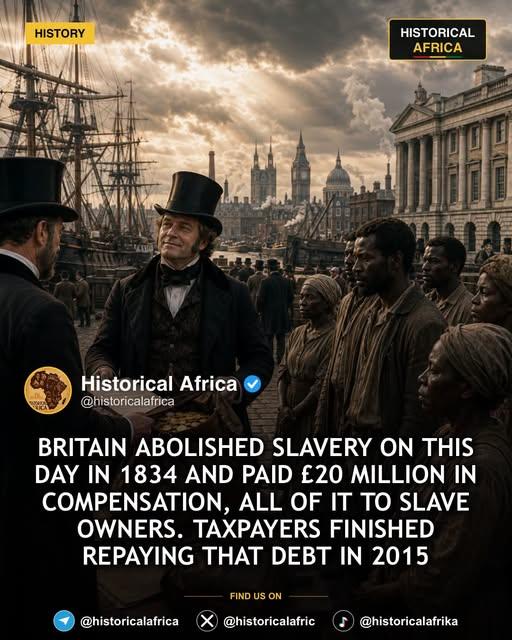
  • On this day in 1834 slavery ended in the British Empire, and the compensation went to the slaveholders
    On 1 August 1834, the Slavery Abolition Act came into force across most of the British Empire. On paper, hundreds of thousands of enslaved Africans and their descendants were declared free. It is remembered as one of the great moral corrections in history, and today it is marked as Emancipation Day across Jamaica, Trinidad and Tobago, Barbados, Guyana, Grenada and beyond.
    But read the full title of the law Britain actually passed. An Act for the Abolition of Slavery throughout the British Colonies, for promoting the Industry of the manumitted Slaves, and for compensating the Persons hitherto entitled to the Services of such Slaves. Compensation. Not for the people who had been owned, worked, whipped and sold. For the people who had owned them.
    Britain paid out around £20 million to more than 40,000 slave owners for the loss of what the law called their property. That sum was roughly 40 percent of the entire national budget at the time, one of the largest payouts in British history. The formerly enslaved received nothing at all. Not land, not wages for generations of stolen labour, not a shilling. As one account of the period put it, the prevailing feeling was that their freedom was compensation enough.
    And freedom itself was delayed. Everyone over the age of six was reclassified as an apprentice, forced to keep working unpaid for their former owners, up to 45 hours a week. Household workers were bound for four years, field workers for six. Slavery had simply changed its name.
    The people it was done to saw through it instantly. On that very first day, 1 August 1834, in Port of Spain, Trinidad, a crowd of mostly elderly formerly enslaved people stood before the Governor as he explained the new arrangement, and drowned him out with a chant. Pas de six ans. Point de six ans. Not six years. No six years. They kept protesting until the system broke. Apprenticeship was abolished early, and full freedom came on 1 August 1838. The enslaved freed themselves from the second trap too.
    Now here is the fact that should be taught in every school on this continent and in the diaspora. Because that £20 million was borrowed and partly converted into government annuities, British taxpayers were still repaying the loan used to compensate slave owners until **2015**. Britain spent 180 years paying the families of slaveholders. It has never paid one penny to the descendants of the enslaved.
    So when Britain says today that reparations are too complicated, too historical, too expensive to calculate, remember that it already calculated the value of every enslaved African with total precision. It just paid the money to the wrong people, and kept paying for nearly two centuries.
    #HistoricalAfrica #EmancipationDay #Reparations #BlackHistory #Slavery
    On this day in 1834 slavery ended in the British Empire, and the compensation went to the slaveholders On 1 August 1834, the Slavery Abolition Act came into force across most of the British Empire. On paper, hundreds of thousands of enslaved Africans and their descendants were declared free. It is remembered as one of the great moral corrections in history, and today it is marked as Emancipation Day across Jamaica, Trinidad and Tobago, Barbados, Guyana, Grenada and beyond. But read the full title of the law Britain actually passed. An Act for the Abolition of Slavery throughout the British Colonies, for promoting the Industry of the manumitted Slaves, and for compensating the Persons hitherto entitled to the Services of such Slaves. Compensation. Not for the people who had been owned, worked, whipped and sold. For the people who had owned them. Britain paid out around £20 million to more than 40,000 slave owners for the loss of what the law called their property. That sum was roughly 40 percent of the entire national budget at the time, one of the largest payouts in British history. The formerly enslaved received nothing at all. Not land, not wages for generations of stolen labour, not a shilling. As one account of the period put it, the prevailing feeling was that their freedom was compensation enough. And freedom itself was delayed. Everyone over the age of six was reclassified as an apprentice, forced to keep working unpaid for their former owners, up to 45 hours a week. Household workers were bound for four years, field workers for six. Slavery had simply changed its name. The people it was done to saw through it instantly. On that very first day, 1 August 1834, in Port of Spain, Trinidad, a crowd of mostly elderly formerly enslaved people stood before the Governor as he explained the new arrangement, and drowned him out with a chant. Pas de six ans. Point de six ans. Not six years. No six years. They kept protesting until the system broke. Apprenticeship was abolished early, and full freedom came on 1 August 1838. The enslaved freed themselves from the second trap too. Now here is the fact that should be taught in every school on this continent and in the diaspora. Because that £20 million was borrowed and partly converted into government annuities, British taxpayers were still repaying the loan used to compensate slave owners until **2015**. Britain spent 180 years paying the families of slaveholders. It has never paid one penny to the descendants of the enslaved. So when Britain says today that reparations are too complicated, too historical, too expensive to calculate, remember that it already calculated the value of every enslaved African with total precision. It just paid the money to the wrong people, and kept paying for nearly two centuries. #HistoricalAfrica #EmancipationDay #Reparations #BlackHistory #Slavery
    0 Комментарии ·0 Поделились ·5Кб Просмотры ·0 предпросмотр
  • Rose Williams was sixteen years old when her enslaver told her she'd been paired with a man named Rufus to produce children. When Rufus climbed into her bed, she grabbed a fireplace poker. Her mistress told her plainly: "De massa wants yous to raise him chillens." Her enslaver threatened the whipping stake if she refused. She thought about her mother — also bought at the same auction — and made the only choice she had. She had two children. The day she was freed, she left and never returned. In 1937, at over ninety years old, she told a government interviewer everything. "I never marries," she said, "'cause one 'sperience am 'nough."
    #BlackHistory #HiddenHistory #AmericanHistory #SlaveryHistory #historymatters
    Rose Williams was sixteen years old when her enslaver told her she'd been paired with a man named Rufus to produce children. When Rufus climbed into her bed, she grabbed a fireplace poker. Her mistress told her plainly: "De massa wants yous to raise him chillens." Her enslaver threatened the whipping stake if she refused. She thought about her mother — also bought at the same auction — and made the only choice she had. She had two children. The day she was freed, she left and never returned. In 1937, at over ninety years old, she told a government interviewer everything. "I never marries," she said, "'cause one 'sperience am 'nough." #BlackHistory #HiddenHistory #AmericanHistory #SlaveryHistory #historymatters
    0 Комментарии ·0 Поделились ·4Кб Просмотры ·0 предпросмотр
  • They Walked Into the Water Rather Than Be Enslaved,they chose death over chains. 🌊 #BlackHistory #UntoldHistory #history
    They Walked Into the Water Rather Than Be Enslaved,they chose death over chains. 🌊 #BlackHistory #UntoldHistory #history
    Sad
    1
    ·
    0 Комментарии ·0 Поделились ·2Кб Просмотры ·0 предпросмотр
  • #slavery #USHistory #BlackHistory
    #slavery #USHistory #BlackHistory
    Sad
    1
    ·
    0 Комментарии ·0 Поделились ·3Кб Просмотры ·0 предпросмотр
  • n 1936, a formerly enslaved man named Prince Smith described it to a government interviewer: a wooden box, barely tall enough to stand in, no room to sit or lie down, locked in direct sunlight for days. Some overseers called it the humane option — because unlike a whip, it left no marks. No visible scars meant no questions from buyers or visitors. The suffering was entirely invisible from the outside. That was exactly the point. His account is in the Library of Congress. So are hundreds like it.
    #BlackHistory #HiddenHistory #AmericanHistory #SlaveryHistory
    n 1936, a formerly enslaved man named Prince Smith described it to a government interviewer: a wooden box, barely tall enough to stand in, no room to sit or lie down, locked in direct sunlight for days. Some overseers called it the humane option — because unlike a whip, it left no marks. No visible scars meant no questions from buyers or visitors. The suffering was entirely invisible from the outside. That was exactly the point. His account is in the Library of Congress. So are hundreds like it. #BlackHistory #HiddenHistory #AmericanHistory #SlaveryHistory
    0 Комментарии ·0 Поделились ·4Кб Просмотры ·0 предпросмотр
  • A soldier in New Orleans in 1815 wrote about a man named George wearing a spiked iron collar that made sleep physically impossible. Four spikes, angled so lying down in any direction drove metal into the ground beneath him. Some collars had bells on iron rods above the wearer's head — so an escaping person could be tracked by sound in the dark. Formerly enslaved man Moses Roper called them "an instrument of torture" in his 1838 memoir. A collar used on a man named Ben after his third escape attempt stayed in the enslaver's family for 175 years before being donated to a museum. Surviving examples are in museums today.
    #BlackHistory #HiddenHistory #AmericanHistory #SlaveryHistory #historymatters
    A soldier in New Orleans in 1815 wrote about a man named George wearing a spiked iron collar that made sleep physically impossible. Four spikes, angled so lying down in any direction drove metal into the ground beneath him. Some collars had bells on iron rods above the wearer's head — so an escaping person could be tracked by sound in the dark. Formerly enslaved man Moses Roper called them "an instrument of torture" in his 1838 memoir. A collar used on a man named Ben after his third escape attempt stayed in the enslaver's family for 175 years before being donated to a museum. Surviving examples are in museums today. #BlackHistory #HiddenHistory #AmericanHistory #SlaveryHistory #historymatters
    Sad
    2
    ·
    1 Комментарии ·0 Поделились ·4Кб Просмотры ·0 предпросмотр
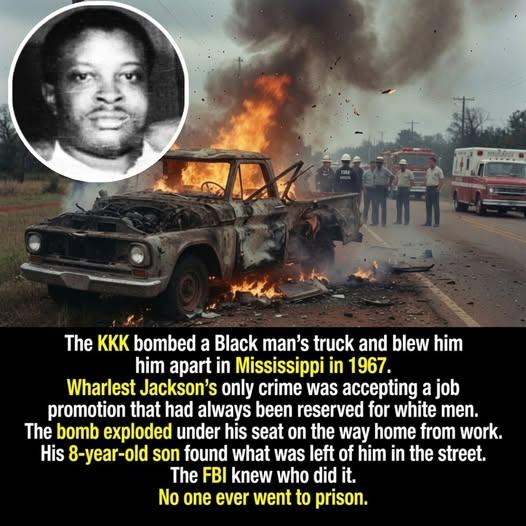
  • On February 27, 1967, Wharlest Jackson Sr., a husband, father, Korean War veteran, and civil rights leader, was murdered in one of the most notorious acts of racial terrorism during the Civil Rights Era.
    Jackson had recently accepted a promotion at the Armstrong Tire and Rubber Company in Natchez, Mississippi. The position had long been reserved for white employees. By earning it, he challenged the racial barriers that had defined the workplace for generations.
    That decision made him a target.
    As he drove home from work, a bomb hidden beneath the driver's seat of his truck exploded, killing him instantly. According to historical accounts, his young son, who was only 8 years old, arrived at the scene and witnessed the devastating aftermath.
    The killing was widely believed to have been carried out by members of the Silver Dollar Group, a violent Ku Klux Klan organization operating in Mississippi.
    Although the FBI identified suspects and conducted an extensive investigation, no one was ever convicted or imprisoned for Jackson's murder.
    Wharlest Jackson's story is a reminder of the deadly consequences many Black Americans faced simply for seeking equal opportunity, fair employment, and basic human dignity.
    Remembering victims like Wharlest Jackson is not about reopening old wounds. It is about preserving the truth, honoring those whose lives were stolen by racial violence, and recognizing the long struggle for equal rights and justice.
    May his memory never be forgotten.
    #WharlestJackson #BlackHistory #CivilRightsMovement #MississippiHistory #RememberTheirNames #NeverForget #Justice #AmericanHistory
    On February 27, 1967, Wharlest Jackson Sr., a husband, father, Korean War veteran, and civil rights leader, was murdered in one of the most notorious acts of racial terrorism during the Civil Rights Era. Jackson had recently accepted a promotion at the Armstrong Tire and Rubber Company in Natchez, Mississippi. The position had long been reserved for white employees. By earning it, he challenged the racial barriers that had defined the workplace for generations. That decision made him a target. As he drove home from work, a bomb hidden beneath the driver's seat of his truck exploded, killing him instantly. According to historical accounts, his young son, who was only 8 years old, arrived at the scene and witnessed the devastating aftermath. The killing was widely believed to have been carried out by members of the Silver Dollar Group, a violent Ku Klux Klan organization operating in Mississippi. Although the FBI identified suspects and conducted an extensive investigation, no one was ever convicted or imprisoned for Jackson's murder. Wharlest Jackson's story is a reminder of the deadly consequences many Black Americans faced simply for seeking equal opportunity, fair employment, and basic human dignity. Remembering victims like Wharlest Jackson is not about reopening old wounds. It is about preserving the truth, honoring those whose lives were stolen by racial violence, and recognizing the long struggle for equal rights and justice. May his memory never be forgotten. #WharlestJackson #BlackHistory #CivilRightsMovement #MississippiHistory #RememberTheirNames #NeverForget #Justice #AmericanHistory
    0 Комментарии ·0 Поделились ·5Кб Просмотры ·0 предпросмотр
  • In 1818, a twelve-year-old girl named Chloe sold at a New Orleans auction for $1,800 — more than the prime field hands who sold the same day for $1,250 each. The buyers called it the “fancy trade.” Enslaved girls chosen for their appearance were auctioned at premium prices, explicitly for forced concubinage, using coded language everyone in the room understood. New Orleans sold over 135,000 people across 50+ documented locations. The bills of sale still exist. Chloe’s last name was never recorded. #fancytrade #blackhistory #AmericanHistory #slavery
    In 1818, a twelve-year-old girl named Chloe sold at a New Orleans auction for $1,800 — more than the prime field hands who sold the same day for $1,250 each. The buyers called it the “fancy trade.” Enslaved girls chosen for their appearance were auctioned at premium prices, explicitly for forced concubinage, using coded language everyone in the room understood. New Orleans sold over 135,000 people across 50+ documented locations. The bills of sale still exist. Chloe’s last name was never recorded. #fancytrade #blackhistory #AmericanHistory #slavery
    Like
    Sad
    2
    ·
    0 Комментарии ·0 Поделились ·3Кб Просмотры ·0 предпросмотр
  • J. Marion Sims — "father of modern gynecology" — developed his surgical techniques on enslaved Black women without anesthesia. One woman, Anarcha, was operated on at least 30 times. Once perfected, the same procedure was performed on white women — with anesthesia. The racial pain bias this was built on has been documented in modern medicine. #nowaythisisreal #truestory #blackhistory #injustice #slavetrade
    J. Marion Sims — "father of modern gynecology" — developed his surgical techniques on enslaved Black women without anesthesia. One woman, Anarcha, was operated on at least 30 times. Once perfected, the same procedure was performed on white women — with anesthesia. The racial pain bias this was built on has been documented in modern medicine. #nowaythisisreal #truestory #blackhistory #injustice #slavetrade
    Sad
    5
    ·
    0 Комментарии ·0 Поделились ·6Кб Просмотры ·0 предпросмотр
  • THE BLACK BROTHERS TURNED INTO A CIRCUS ATTRACTION
    Do you know two Black brothers with albinism were once kidnapped from their mother and turned into a traveling circus attraction so crowds could pay money to stare at them?
    Their names were George and Willie Muse.
    Born in Truevine near Roanoke, Virginia, the brothers grew up during segregation-era America with albinism, a rare condition that gave them pale skin, light hair, and poor eyesight.
    In 1899, a white circus recruiter named James Herman “Candy” Shelton targeted the brothers after seeing them near tobacco fields in Virginia.
    Their mother Harriet Muse refused to let them join traveling circus shows.
    But later, the brothers were taken away from their family and pulled into the brutal world of American sideshows.
    Circus promoters renamed them “Eko” and “Iko.”
    Posters advertised them as strange attractions while white crowds across America paid money to stare at them beneath carnival tents.
    Meanwhile, their mother spent thirteen years searching for her sons.
    And when she finally found them again years later, the brothers had already spent much of their lives being displayed as entertainment across segregated America.
    Because while audiences saw a spectacle…
    their mother saw her children.
    Support to keep HISTORA alive. The full archive is available at historalegacy.com.
    We do not glorify violence. We reveal truth so history can’t repeat itself.
    #histora #blackhistory #history #truevine #georgemuse #williemuse #hiddenhistory #americanhistory
    THE BLACK BROTHERS TURNED INTO A CIRCUS ATTRACTION Do you know two Black brothers with albinism were once kidnapped from their mother and turned into a traveling circus attraction so crowds could pay money to stare at them? Their names were George and Willie Muse. Born in Truevine near Roanoke, Virginia, the brothers grew up during segregation-era America with albinism, a rare condition that gave them pale skin, light hair, and poor eyesight. In 1899, a white circus recruiter named James Herman “Candy” Shelton targeted the brothers after seeing them near tobacco fields in Virginia. Their mother Harriet Muse refused to let them join traveling circus shows. But later, the brothers were taken away from their family and pulled into the brutal world of American sideshows. Circus promoters renamed them “Eko” and “Iko.” Posters advertised them as strange attractions while white crowds across America paid money to stare at them beneath carnival tents. Meanwhile, their mother spent thirteen years searching for her sons. And when she finally found them again years later, the brothers had already spent much of their lives being displayed as entertainment across segregated America. Because while audiences saw a spectacle… their mother saw her children. Support to keep HISTORA alive. The full archive is available at historalegacy.com. We do not glorify violence. We reveal truth so history can’t repeat itself. #histora #blackhistory #history #truevine #georgemuse #williemuse #hiddenhistory #americanhistory
    Like
    Sad
    Wow
    Angry
    6
    ·
    0 Комментарии ·0 Поделились ·7Кб Просмотры ·0 предпросмотр
Расширенные страницы