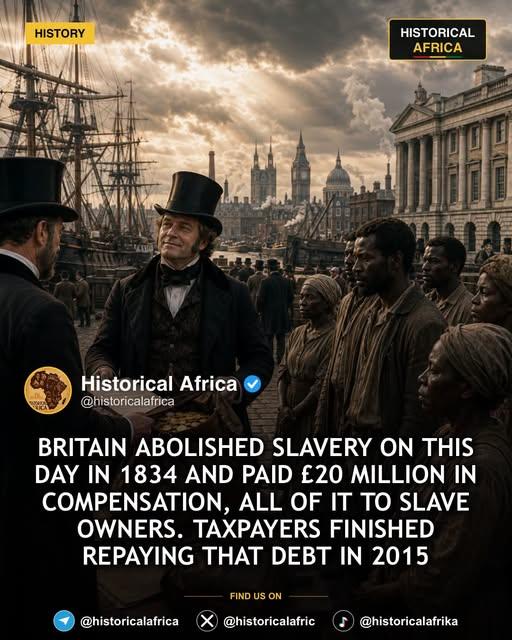


On this day in 1834 slavery ended in the British Empire, and the compensation went to the slaveholders
On 1 August 1834, the Slavery Abolition Act came into force across most of the British Empire. On paper, hundreds of thousands of enslaved Africans and their descendants were declared free. It is remembered as one of the great moral corrections in history, and today it is marked as Emancipation Day across Jamaica, Trinidad and Tobago, Barbados, Guyana, Grenada and beyond.
But read the full title of the law Britain actually passed. An Act for the Abolition of Slavery throughout the British Colonies, for promoting the Industry of the manumitted Slaves, and for compensating the Persons hitherto entitled to the Services of such Slaves. Compensation. Not for the people who had been owned, worked, whipped and sold. For the people who had owned them.
Britain paid out around £20 million to more than 40,000 slave owners for the loss of what the law called their property. That sum was roughly 40 percent of the entire national budget at the time, one of the largest payouts in British history. The formerly enslaved received nothing at all. Not land, not wages for generations of stolen labour, not a shilling. As one account of the period put it, the prevailing feeling was that their freedom was compensation enough.
And freedom itself was delayed. Everyone over the age of six was reclassified as an apprentice, forced to keep working unpaid for their former owners, up to 45 hours a week. Household workers were bound for four years, field workers for six. Slavery had simply changed its name.
The people it was done to saw through it instantly. On that very first day, 1 August 1834, in Port of Spain, Trinidad, a crowd of mostly elderly formerly enslaved people stood before the Governor as he explained the new arrangement, and drowned him out with a chant. Pas de six ans. Point de six ans. Not six years. No six years. They kept protesting until the system broke. Apprenticeship was abolished early, and full freedom came on 1 August 1838. The enslaved freed themselves from the second trap too.
Now here is the fact that should be taught in every school on this continent and in the diaspora. Because that £20 million was borrowed and partly converted into government annuities, British taxpayers were still repaying the loan used to compensate slave owners until **2015**. Britain spent 180 years paying the families of slaveholders. It has never paid one penny to the descendants of the enslaved.
So when Britain says today that reparations are too complicated, too historical, too expensive to calculate, remember that it already calculated the value of every enslaved African with total precision. It just paid the money to the wrong people, and kept paying for nearly two centuries.
#HistoricalAfrica #EmancipationDay #Reparations #BlackHistory #Slavery
On 1 August 1834, the Slavery Abolition Act came into force across most of the British Empire. On paper, hundreds of thousands of enslaved Africans and their descendants were declared free. It is remembered as one of the great moral corrections in history, and today it is marked as Emancipation Day across Jamaica, Trinidad and Tobago, Barbados, Guyana, Grenada and beyond.
But read the full title of the law Britain actually passed. An Act for the Abolition of Slavery throughout the British Colonies, for promoting the Industry of the manumitted Slaves, and for compensating the Persons hitherto entitled to the Services of such Slaves. Compensation. Not for the people who had been owned, worked, whipped and sold. For the people who had owned them.
Britain paid out around £20 million to more than 40,000 slave owners for the loss of what the law called their property. That sum was roughly 40 percent of the entire national budget at the time, one of the largest payouts in British history. The formerly enslaved received nothing at all. Not land, not wages for generations of stolen labour, not a shilling. As one account of the period put it, the prevailing feeling was that their freedom was compensation enough.
And freedom itself was delayed. Everyone over the age of six was reclassified as an apprentice, forced to keep working unpaid for their former owners, up to 45 hours a week. Household workers were bound for four years, field workers for six. Slavery had simply changed its name.
The people it was done to saw through it instantly. On that very first day, 1 August 1834, in Port of Spain, Trinidad, a crowd of mostly elderly formerly enslaved people stood before the Governor as he explained the new arrangement, and drowned him out with a chant. Pas de six ans. Point de six ans. Not six years. No six years. They kept protesting until the system broke. Apprenticeship was abolished early, and full freedom came on 1 August 1838. The enslaved freed themselves from the second trap too.
Now here is the fact that should be taught in every school on this continent and in the diaspora. Because that £20 million was borrowed and partly converted into government annuities, British taxpayers were still repaying the loan used to compensate slave owners until **2015**. Britain spent 180 years paying the families of slaveholders. It has never paid one penny to the descendants of the enslaved.
So when Britain says today that reparations are too complicated, too historical, too expensive to calculate, remember that it already calculated the value of every enslaved African with total precision. It just paid the money to the wrong people, and kept paying for nearly two centuries.
#HistoricalAfrica #EmancipationDay #Reparations #BlackHistory #Slavery
On this day in 1834 slavery ended in the British Empire, and the compensation went to the slaveholders
On 1 August 1834, the Slavery Abolition Act came into force across most of the British Empire. On paper, hundreds of thousands of enslaved Africans and their descendants were declared free. It is remembered as one of the great moral corrections in history, and today it is marked as Emancipation Day across Jamaica, Trinidad and Tobago, Barbados, Guyana, Grenada and beyond.
But read the full title of the law Britain actually passed. An Act for the Abolition of Slavery throughout the British Colonies, for promoting the Industry of the manumitted Slaves, and for compensating the Persons hitherto entitled to the Services of such Slaves. Compensation. Not for the people who had been owned, worked, whipped and sold. For the people who had owned them.
Britain paid out around £20 million to more than 40,000 slave owners for the loss of what the law called their property. That sum was roughly 40 percent of the entire national budget at the time, one of the largest payouts in British history. The formerly enslaved received nothing at all. Not land, not wages for generations of stolen labour, not a shilling. As one account of the period put it, the prevailing feeling was that their freedom was compensation enough.
And freedom itself was delayed. Everyone over the age of six was reclassified as an apprentice, forced to keep working unpaid for their former owners, up to 45 hours a week. Household workers were bound for four years, field workers for six. Slavery had simply changed its name.
The people it was done to saw through it instantly. On that very first day, 1 August 1834, in Port of Spain, Trinidad, a crowd of mostly elderly formerly enslaved people stood before the Governor as he explained the new arrangement, and drowned him out with a chant. Pas de six ans. Point de six ans. Not six years. No six years. They kept protesting until the system broke. Apprenticeship was abolished early, and full freedom came on 1 August 1838. The enslaved freed themselves from the second trap too.
Now here is the fact that should be taught in every school on this continent and in the diaspora. Because that £20 million was borrowed and partly converted into government annuities, British taxpayers were still repaying the loan used to compensate slave owners until **2015**. Britain spent 180 years paying the families of slaveholders. It has never paid one penny to the descendants of the enslaved.
So when Britain says today that reparations are too complicated, too historical, too expensive to calculate, remember that it already calculated the value of every enslaved African with total precision. It just paid the money to the wrong people, and kept paying for nearly two centuries.
#HistoricalAfrica #EmancipationDay #Reparations #BlackHistory #Slavery