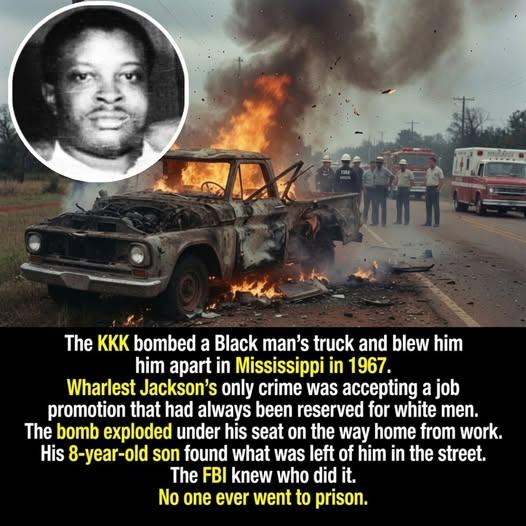


On February 27, 1967, Wharlest Jackson Sr., a husband, father, Korean War veteran, and civil rights leader, was murdered in one of the most notorious acts of racial terrorism during the Civil Rights Era.
Jackson had recently accepted a promotion at the Armstrong Tire and Rubber Company in Natchez, Mississippi. The position had long been reserved for white employees. By earning it, he challenged the racial barriers that had defined the workplace for generations.
That decision made him a target.
As he drove home from work, a bomb hidden beneath the driver's seat of his truck exploded, killing him instantly. According to historical accounts, his young son, who was only 8 years old, arrived at the scene and witnessed the devastating aftermath.
The killing was widely believed to have been carried out by members of the Silver Dollar Group, a violent Ku Klux Klan organization operating in Mississippi.
Although the FBI identified suspects and conducted an extensive investigation, no one was ever convicted or imprisoned for Jackson's murder.
Wharlest Jackson's story is a reminder of the deadly consequences many Black Americans faced simply for seeking equal opportunity, fair employment, and basic human dignity.
Remembering victims like Wharlest Jackson is not about reopening old wounds. It is about preserving the truth, honoring those whose lives were stolen by racial violence, and recognizing the long struggle for equal rights and justice.
May his memory never be forgotten.
#WharlestJackson #BlackHistory #CivilRightsMovement #MississippiHistory #RememberTheirNames #NeverForget #Justice #AmericanHistory
Jackson had recently accepted a promotion at the Armstrong Tire and Rubber Company in Natchez, Mississippi. The position had long been reserved for white employees. By earning it, he challenged the racial barriers that had defined the workplace for generations.
That decision made him a target.
As he drove home from work, a bomb hidden beneath the driver's seat of his truck exploded, killing him instantly. According to historical accounts, his young son, who was only 8 years old, arrived at the scene and witnessed the devastating aftermath.
The killing was widely believed to have been carried out by members of the Silver Dollar Group, a violent Ku Klux Klan organization operating in Mississippi.
Although the FBI identified suspects and conducted an extensive investigation, no one was ever convicted or imprisoned for Jackson's murder.
Wharlest Jackson's story is a reminder of the deadly consequences many Black Americans faced simply for seeking equal opportunity, fair employment, and basic human dignity.
Remembering victims like Wharlest Jackson is not about reopening old wounds. It is about preserving the truth, honoring those whose lives were stolen by racial violence, and recognizing the long struggle for equal rights and justice.
May his memory never be forgotten.
#WharlestJackson #BlackHistory #CivilRightsMovement #MississippiHistory #RememberTheirNames #NeverForget #Justice #AmericanHistory
On February 27, 1967, Wharlest Jackson Sr., a husband, father, Korean War veteran, and civil rights leader, was murdered in one of the most notorious acts of racial terrorism during the Civil Rights Era.
Jackson had recently accepted a promotion at the Armstrong Tire and Rubber Company in Natchez, Mississippi. The position had long been reserved for white employees. By earning it, he challenged the racial barriers that had defined the workplace for generations.
That decision made him a target.
As he drove home from work, a bomb hidden beneath the driver's seat of his truck exploded, killing him instantly. According to historical accounts, his young son, who was only 8 years old, arrived at the scene and witnessed the devastating aftermath.
The killing was widely believed to have been carried out by members of the Silver Dollar Group, a violent Ku Klux Klan organization operating in Mississippi.
Although the FBI identified suspects and conducted an extensive investigation, no one was ever convicted or imprisoned for Jackson's murder.
Wharlest Jackson's story is a reminder of the deadly consequences many Black Americans faced simply for seeking equal opportunity, fair employment, and basic human dignity.
Remembering victims like Wharlest Jackson is not about reopening old wounds. It is about preserving the truth, honoring those whose lives were stolen by racial violence, and recognizing the long struggle for equal rights and justice.
May his memory never be forgotten.
#WharlestJackson #BlackHistory #CivilRightsMovement #MississippiHistory #RememberTheirNames #NeverForget #Justice #AmericanHistory