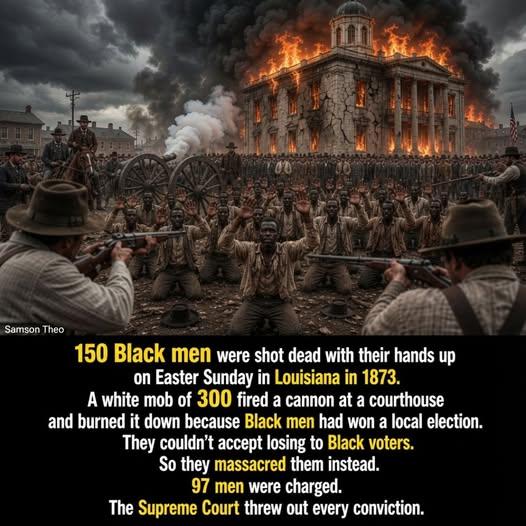


One of the deadliest acts of political violence in American history happened on Easter Sunday and most people have never heard of it.
On April 13, 1873, in Colfax, Louisiana, hundreds of armed white supremacists attacked the Grant Parish courthouse, where Black citizens and members of the state militia had gathered to defend the results of a disputed local election during Reconstruction.
Just five years after the Civil War ended, Black men had gained the right to vote and hold public office. In Grant Parish, they helped elect Republican officials. Many white Democrats refused to accept the outcome.
Determined to seize power by force, an estimated 300 armed men surrounded the courthouse. They fired a cannon into the building and set it ablaze. As the defenders tried to surrender or escape, many were shot where they stood. Others were hunted down and executed after being captured.
Historians estimate that at least 150 Black men were killed in what became known as the Colfax Massacre, making it one of the bloodiest racial massacres of the Reconstruction era.
Federal authorities charged 97 men under the Enforcement Acts, laws designed to protect the civil rights of newly freed African Americans.
But in 1876, the U.S. Supreme Court overturned the convictions in United States v. Cruikshank, ruling that the federal government had only limited power to prosecute individuals for violating the civil rights of others. The decision severely weakened federal enforcement against racial terrorism and emboldened white supremacist groups across the South for decades.
No one was ultimately held accountable for the massacre.
The Colfax Massacre remains a powerful reminder of the violent resistance that followed emancipation and of the long struggle to protect the right to vote in the United States.
History should be remembered not forgotten.
On April 13, 1873, in Colfax, Louisiana, hundreds of armed white supremacists attacked the Grant Parish courthouse, where Black citizens and members of the state militia had gathered to defend the results of a disputed local election during Reconstruction.
Just five years after the Civil War ended, Black men had gained the right to vote and hold public office. In Grant Parish, they helped elect Republican officials. Many white Democrats refused to accept the outcome.
Determined to seize power by force, an estimated 300 armed men surrounded the courthouse. They fired a cannon into the building and set it ablaze. As the defenders tried to surrender or escape, many were shot where they stood. Others were hunted down and executed after being captured.
Historians estimate that at least 150 Black men were killed in what became known as the Colfax Massacre, making it one of the bloodiest racial massacres of the Reconstruction era.
Federal authorities charged 97 men under the Enforcement Acts, laws designed to protect the civil rights of newly freed African Americans.
But in 1876, the U.S. Supreme Court overturned the convictions in United States v. Cruikshank, ruling that the federal government had only limited power to prosecute individuals for violating the civil rights of others. The decision severely weakened federal enforcement against racial terrorism and emboldened white supremacist groups across the South for decades.
No one was ultimately held accountable for the massacre.
The Colfax Massacre remains a powerful reminder of the violent resistance that followed emancipation and of the long struggle to protect the right to vote in the United States.
History should be remembered not forgotten.
One of the deadliest acts of political violence in American history happened on Easter Sunday and most people have never heard of it.
On April 13, 1873, in Colfax, Louisiana, hundreds of armed white supremacists attacked the Grant Parish courthouse, where Black citizens and members of the state militia had gathered to defend the results of a disputed local election during Reconstruction.
Just five years after the Civil War ended, Black men had gained the right to vote and hold public office. In Grant Parish, they helped elect Republican officials. Many white Democrats refused to accept the outcome.
Determined to seize power by force, an estimated 300 armed men surrounded the courthouse. They fired a cannon into the building and set it ablaze. As the defenders tried to surrender or escape, many were shot where they stood. Others were hunted down and executed after being captured.
Historians estimate that at least 150 Black men were killed in what became known as the Colfax Massacre, making it one of the bloodiest racial massacres of the Reconstruction era.
Federal authorities charged 97 men under the Enforcement Acts, laws designed to protect the civil rights of newly freed African Americans.
But in 1876, the U.S. Supreme Court overturned the convictions in United States v. Cruikshank, ruling that the federal government had only limited power to prosecute individuals for violating the civil rights of others. The decision severely weakened federal enforcement against racial terrorism and emboldened white supremacist groups across the South for decades.
No one was ultimately held accountable for the massacre.
The Colfax Massacre remains a powerful reminder of the violent resistance that followed emancipation and of the long struggle to protect the right to vote in the United States.
History should be remembered not forgotten.